 7:16
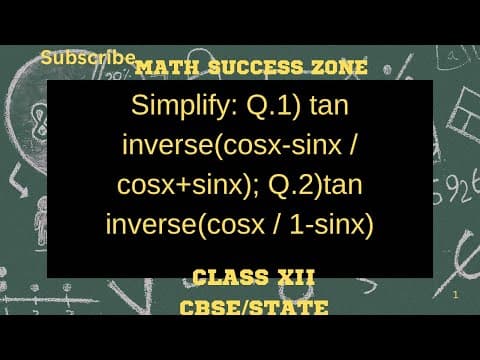
7:16Simplifying Inverse Trigonometric Expressions
Five worked simplifications of inverse trigonometric expressions, using trig substitutions and the tangent compound-angle identities to reduce each one to a clean closed form.
Watch lesson →Learn how to find the principal value of inverse trigonometric functions, using their domains and ranges together with the quadrant signs to pick the correct angle.
This Class 12 lesson works through finding principal values of inverse trigonometric functions. It starts with the definitions and the domain and range table for all six inverse functions, then solves a series of examples for positive and negative inputs, using the signs of the ratios in each quadrant to land on the angle that lies inside the correct range. It finishes with composite questions of the form arcsin(sin x) where the inner angle must be rewritten to fall within the principal range.
This lesson explains how to find the principal value of an inverse trigonometric function. It starts from the definitions and the domain and range table, then works through examples with positive and negative inputs, and finishes with composite expressions like .
If then , and the same pattern gives the other five inverse functions: , , , , and . Note that means the inverse function, not the reciprocal .
The range of each inverse function is its principal value branch.
Example. . Let , so , giving . Since , the principal value is .
Example. . Here , so , which lies in . The principal value is .
Example. . Here , so , which lies in the range. The principal value is .
To handle negative inputs, recall where each ratio is positive:
For a reference angle , the angle in the second quadrant is , in the third is , and in the fourth is . Choose the quadrant whose angle lands inside the function's range.
Example. . Here , with reference angle since . Sine is negative in the third and fourth quadrants. The third quadrant gives , which is outside . The fourth quadrant gives , which is inside. So the principal value is .
Example. . Here , reference angle . Cotangent is negative in the second and fourth quadrants. The second quadrant gives , which lies in . The principal value is .
Example. . Here , reference angle . Tangent is negative in the second and fourth quadrants. The second quadrant gives (outside the range); the fourth gives , which lies in . The principal value is .
Example. . Here , reference angle . Secant is negative in the second and third quadrants. The second quadrant gives , which lies in the range . The principal value is .
While only when lies in the principal range, otherwise rewrite the inner angle first.
Example. . Since is outside , use to write . Then , which is in range.
Example. . Here is outside the range, so . Since is in range, the answer is .
Example. . Since is outside and , we have , so the answer is .
7:16Five worked simplifications of inverse trigonometric expressions, using trig substitutions and the tangent compound-angle identities to reduce each one to a clean closed form.
Watch lesson → 10:03
10:03Worked solutions to the key questions of Class 12 inverse trigonometry Exercise 2.2, using the substitution trick to prove identities and simplify expressions.
Watch lesson → 3:44
3:44A quick reference run through the key inverse trigonometry identities for Class 12, covering negative arguments, complementary pairs, and the double-angle and sum results.
Watch lesson →